


A publication by Valérie Sallaz, independent educational designer. Valérie teaches management and project management, advises companies, and draws on her experience as an interactive designer, notably acquired at Daesign.
This article recounts an experience teaching management in initial training (master’s level), based primarily on the use of serious games in the classroom. It analyzes the impact of this method on the trainer’s approach and offers food for thought on the support tools that should be made available to teachers and trainers. At this stage, in the absence of a quantified assessement of the skills acquired and a comparison with the results obtaines using a traditional approach, it concludes by presenting the students’ qualitative perception of the value of this teaching method. Given the profile of the students, the size of the groups, and the teaching scenarios used, these conclusions appear to be perfectly applicable to continuing education in companies.
From design to animation
As a designer of serious games for over 10 years, specializing in simulations and managerial scenarios, I have approached numerous training projects from the perspective of customer need. These needs were most often expressed in terms of expected return on investment (ROI) and therefore measurable educational effectiveness. How can this be achieved? In the case of serious games, this effectiveness stems from careful work on game design and its close integration with the scenario, objectives, and educational content. This promotes engagement and sustained attention, and helps to reinforce the knowledge and skills acquired over time.
I now devote part of my time to teaching; I work with Master 2 students specializing in Strategy and Digital Communication (University of Savoie Mont-Blanc) and Master 1 Transmedia students (Sciences Po Grenoble) on the topics of management and project management.
I naturally chose serious games as my teaching method and made them the backbone of my course. In agreement with Daesign, a leading publisher in the filed, I decided to base the sessions (about 15 hours per group) on the use of three serious games from its catalog:
- Time management
- Delegating a task/assignment
- Remote management
The outcome of the experiment was very positive: I was able to see how effective the tool is and how much learners enjoy using it. But above all, I was able to gauge the impact of using serious games in the classroom on the role of the trainer. Course preparation, teaching methods, and classroom behaviour have all been transformed.
As a designer, my questions were: “Will the interaction between the learner and the serious game unfold as I imagine it will, and wiil it deliver the benefits that the product promises?”.
As a trainer, this question became: “When I see students getting involved, thinking out lound, challenging each other… what approach should I take as a trainer during the session to capitalize on this energy?”.
At the end of the experiment, I identified three approaches…
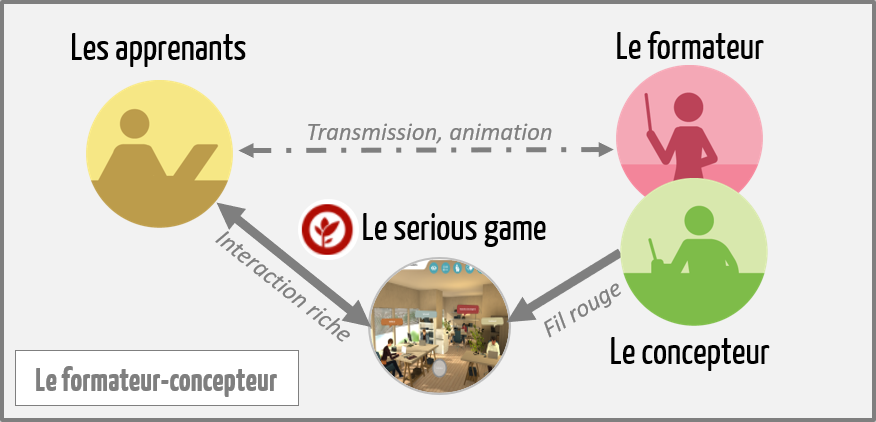
1. The trainer-designer
This is the very specific -and obviously not generalizable- case I found myself in during the first sessions. I used two serious games that I had actively contributed to writing, and whose scenario, gameplay, interface, and above all model I was familiar with.
By “model”, I mean the set of rules, principles, best practices, and tolls used as a reference, and the way in which the scenario articulates them to determine the sequence of actions, the calculation of the score, the choice of feedback… everything that constitutes the learner’s journey and progress.
In fact, having myself created or co-created the models underlying the simulations and their staging, I was well equipped to receive, and even anticipate, any comments or questions from the learners, and to respond to them in a reasoned manner.
So, I naturally placed the use of serious games at the heart of the course sessions. I made them the common thread and main support. The students (12 in total) played in subgroups or collectively. The session was systematically followed by a collective debriefing. I covered the parts of the programme not covered by the games in a traditional way (theory and practical cases) in separate sessions.
In a nutshell:
- Once launched, serious game sequences generate their own momentum, and this will be the case every time: students get hooked, engage with their choices, interact with each other and with the game.
- Educational messages are conveyed through the exchanges that arise naturally during the game sequences. It is then easy to explain and highlight them during the debriefing, which gives rise to numerous comments and debates.
Traditional class sequences are then experienced as a break with the previous ones, and it is difficult to maintain continuity and fluidity.
2. The trainer-user
This is the most common scenario, which I had already observed in various projects. The serious game os provided to the trianer as a teaching tool (just like textbooks or other materials, digital or otherwise), and the trainer incorporates it into their course, in one or more sequences.
I had the opportunity to approach this posture, because one of the serious games I used was not as familiar to me as the others. I had practiced it, I knew the scenario and the principles, but I did not master the underlying model.
I implemented the same teaching methods as in the forst sessions, favoring use in subgroups and/or as a group, followed by a discussion.
In a nutshell:
- The game and feedback sequences are interactive and dynamic, as before.
- So it is still very positive, but it is a double-edged sword… The questions, criticisms, and ideas raised by the students are abundant: “Why did this happened?”, “If we had made that choice, what would have happened?”. It can sometimes be tricky to answer these questions, which concern the fundamentals of the game… just as it can be tricky not to answer them. And it can be frustrating, because these moments are always an opportunity for constructive discussion that aids learning.
- Similarly, it is difficult to step outside the framework provided by the game and leave room for improvisation and adaptation. Yet both are necessary because the students -and this is the goal- are not afraid to step outside the box. Adopting deliberately counterproductive strategies (in order words, “doing everything wrong”) and seeing what consequences they generate is often their first instinct. This can be done for fun, but it is even better to exploit it pedagogically by discussing the effects obtaines and their causes.
3. The master trainer of the game
Hardened by these initial experiences, I approached the final sessions differently. I worked with the game designers until I had a thorough understanding of the theoretical foundations, biases, general philosophy, and specific cases. I then designed a structure centered around the serious game, as in the other cases, but I enriched the feedback sequences by spending more time extracting key ideas, best practices to remember, and related theoretical knowledge, whether or not covered by the serious game, at varying levels of depth.
In other words, I made the serious game not only the initial delivery medium, but also the basis for building the rest of the course.
In a nutshell:
- The game sequences displayed the same level of intensity and interaction. The questions, suggestions, opinions, and debates demonstrated the game’s ability to stimulate active, engaged, and spontaneous learning.
- The session flows smoothly, forming a coherent whole without any breaks in rhythm.
- The students had maximum freedom. It was possible to adapt in real time to their ideas, desires, and sometimes challenges, always emphasizing what they were projecting and then what they were getting out of it, if deemed relevant.
- My freedom as a trainer was also maximized. This was evident in two key prerogatives of the traditional role-playing game master:
- The game master defines the missions: they rely on the serious game scenario but can choose to deviate from it, for example, by asking learners for an unconventional result that forces them to think differently and provides an oblique perspective, allowing them to experience different consequences and new challenges.
- They hold and express “the truth of the game”. The trainer is fully responsible for answering any questions from learners that are not provided by the serious game itself. They are free to weave their own vision into that of the game, giving them an additional opportunity to guide students towards relevant and constuctive reflections.
From this point on, the term “game master” takes on its full meaning. And the word “game” refers both to the serious game, which the trainer masters and uses as they see fit, and to the entire learning session.
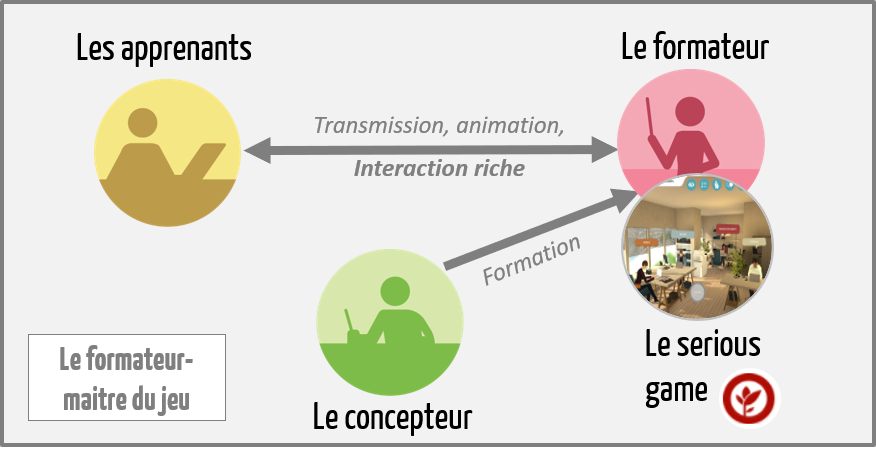
In their role as game master, trainers draw on their personal expertise, knowledge, and vision of the subject they are teaching. They play a comprehensive, cross-funcitonal role.
Serious games: a superpower for trainers?
At this stage, let’s not go that far, but the use of serious games is a real benefit, regardless of the apporach taken, because:
- The level of interaction is high: between students and the game, between students themselves, and between students and their trainer. Interactive means lively, dynamic, engaging… excellent conditions for effective learning.
- The formats are varied: educational messages are conveyed through instructions, animations, dialogues, feedback… and, of course, through the many choices offered to the learner. Variety means no boredom, but also complexity, challenge, and the use of cognitive abilities and creativity.
- Serious games, and simulations in particular, allow players to try, gauge, restart, compare, and more. Trial and error learning means progress.
- Gameplay, with missions, objectives, difficulty levels, challenges, scores, etc., makes a serious game worthy of the name. Games mean fun and motivation.
Added to this is the freedom of action offered to learners, a fluid session conductive to exchanges from start to finish… if you are in the position of trainer-game master. This therefore requires knowledge of the intricacies of serious games.
But what resources does the trainer have at their disposal to achieve this? Training by the designers, of course, but also playing, playing, and playing some more… testing through a pilot session, which is always rich in lessons. The price is not so high if you look closely, especially since the tume invested initially will be recouped by sessions that are easier to prepare. And of course, there’s no question of doing it alone.
Training provided by the people who designed the tool is a simple and accessible solution, but other tools, such as trainer’s guides (paper, and/or online and interactive), can meet the need in a lighter and more flexible way.
It is up to publishers to integrate classroom use into the design of serious games and to provide the associated tools. These will enable trainers to quickly and easily familiarize themselves with the products and combine them with their own expertise. Everyone will benefit, especially the learners.
So… what do they say?
Student reviews
I will return to the students’ detailed reactions during and after the sessions in a later article. In the meantime, an online questionnaire has provided me with some initial feedback. For each statement, students responded on a scale from 0, meaning “Strongly disagree”, to 5, meaning “Strongly agree”.
Here are the results for questions concerning their overall interest in using serious games:
| Affirmation | Average score obtained/5 |
| The use os serious games made the course:
. More lively . More modern . More effective for learning |
4,8
4,7 4 |
| Compared to a “traditional” course, I feel that:
. I understood better . I retained/memorized better . I will be better able to apply what I learned |
4,1
4,2 4,2 |
| Pedagogically, it is interesting because:
. We get involved, se we concentrate . We confront our choices . We compare the virtual situation with our experience |
4,6
4,5 4,2 |
Although subjective for now, these results are very encouraging and will be extended next year to a panel of more than 100 students, allowing for the implementation, testing, and comparison of several methods. There’s plenty to look forward to…