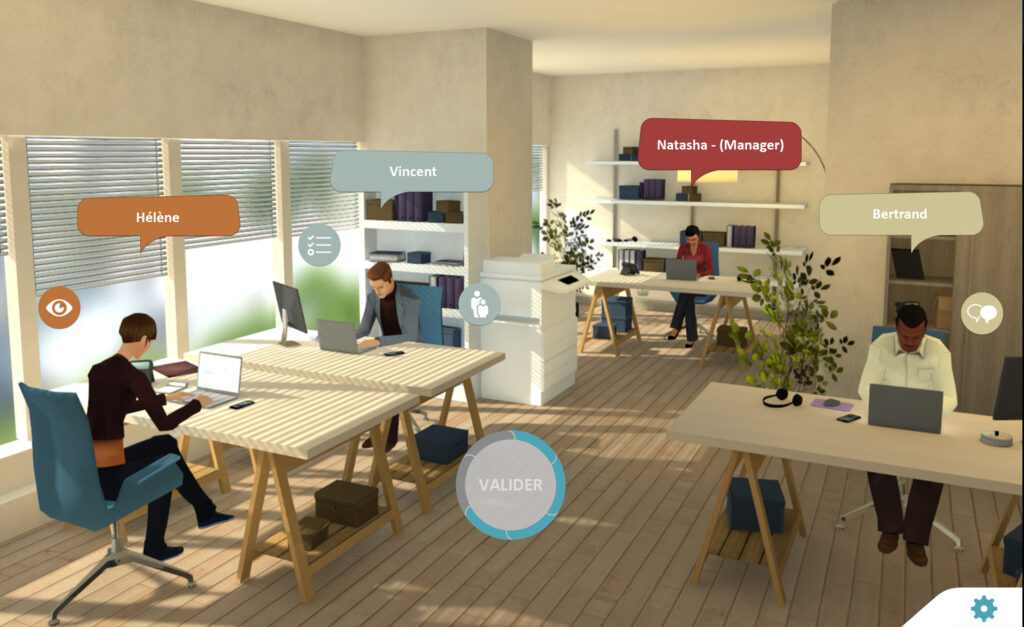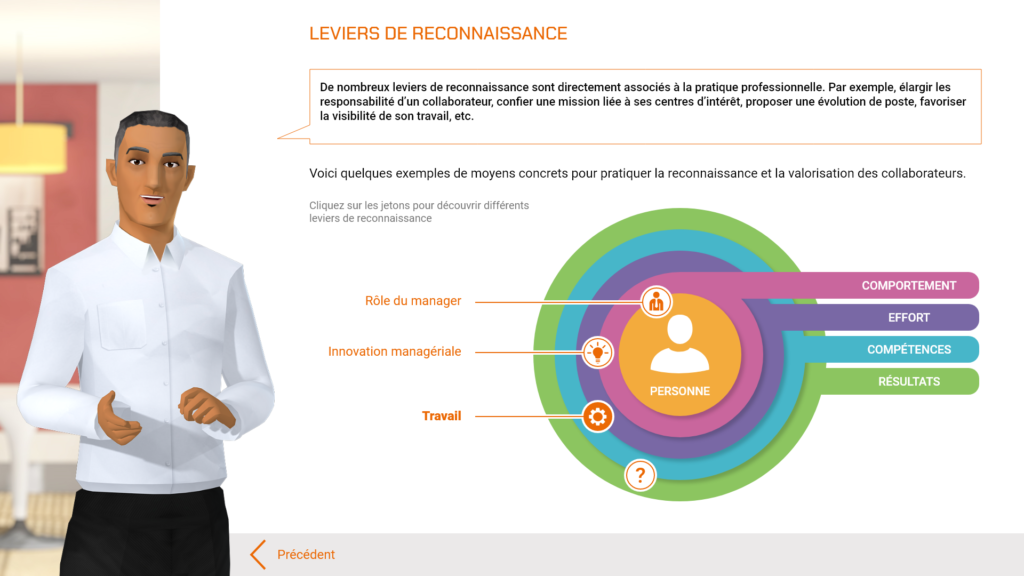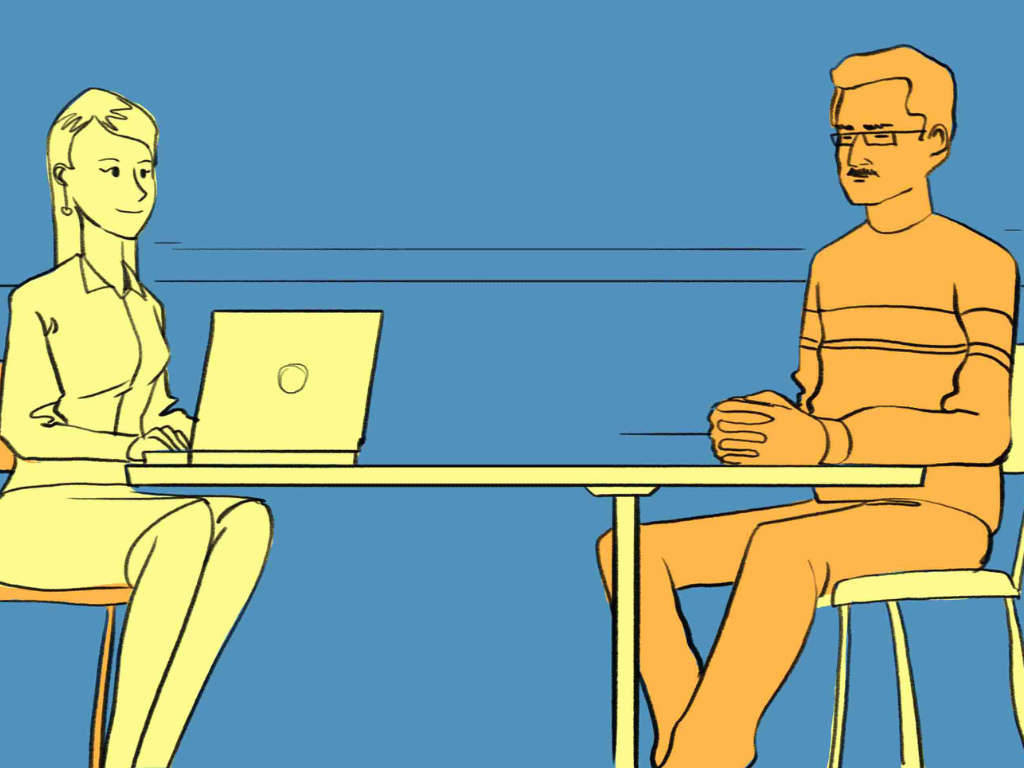


A specialist dialogue simulator on conflict management, to practise managing tension face-to-face without clashing with anyone.
LEARNING OBJECTIVES
- Develop listening skills that overcome the effects of aggression
- Remain assertive and constructive in any situation
- Identify the causes of conflicts and the real challenges
- Take back the initiative and re-orientate the debate
- Separate negotiable and non-negotiable
- Bring out viable options
- Find the best way out
TEACHING METHODS
- 1 dialogue simulation (3 chapters)
- 5 video clips
- 1 evaluation quiz
- 10 memo cards
- 1 certificate of achievement
HIGHLIGHTS
- A unique tool that allows you to practice on your own without damage when faced with a resisting interlocutor
- Designed with Natixis, PwC and Orange
In a constantly changing professional environment, the ability to transform a tense situation into a lever for progress is a key strategic skill. Conflict management training should no longer be viewed as a simple theoretical module, but as a genuine behavioral transformation experience for leaders and their teams. At Daesign, we are convinced that mastering interpersonal relationships requires an immersive approach in which employees become the main actors in their own change. By placing individuals at the heart of realistic scenarios, we enable them to acquire concrete reflexes to defuse crises and restore a climate of lasting trust within organizations.
Why theory is no longer sufficient in the face of operational conflicts
The observation is often the same within companies: theoretical knowledge of communication mechanisms does not guarantee an appropriate response during a peak of stress. When faced with aggression or resistance from another person, the human brain often favors instinctive defense mechanisms rather than reasoned strategies. To overcome this, it is essential to expose managers to real-life situations through educational programs that engage both the emotions and the intellect. Experiential learning allows participants to test different mediation approaches without fear of failure, thereby promoting a deep understanding of the nonverbal communication and emotional regulation techniques that are essential in the workplace.
The human and financial cost of poorly managed tensions
The impact of persistent disagreement within a department goes far beyond simple personal affinities, as it directly affects the overall productivity of the company. When a crisis situation arises, there is an immediate decline in motivation, a significant increase in absenteeism, and, ultimately, a drain on the most qualified talent. Investing in an effective psychosocial risk prevention strategy can limit these losses by providing managers with the tools they need to identify early warning signs before the situation escalates. By attending a webinar dedicated to managing tensions, your teams will learn how to anticipate differences of interest and transform them into constructive dialogues, thereby preserving your organization’s human capital and economic performance.
The ineffectiveness of top-down methods on soft skills
Traditional training formats, based on top-down knowledge transfer, quickly reveal their limitations when it comes to changing behaviors that have been ingrained for years. Soft skills cannot be taught with slides; they are learned through practice and critical analysis of one’s own spontaneous reactions to a conflict. For a problem-solving method to be truly adopted, learners must feel the need to change their leadership style through simulated social interactions. It is by experiencing the direct consequences of their choice of words and attitude that professionals develop active listening and empathy skills, which are essential for conducting complex negotiations or appeasing legitimate frustration.
The urgency of re-engaging employees in their learning
Faced with information overload, the educational format must be reinvented to capture attention and encourage voluntary engagement on the part of employees. Content that is too academic risks causing rapid disinterest, rendering the company’s investment completely fruitless in the long term. To counter this phenomenon, Daesign offers innovative courses that stimulate curiosity and the desire to progress through games and personal challenges. By opting for distance learning on crisis resolution, users benefit from total flexibility while remaining immersed in a stimulating environment that promotes long-term information retention and encourages the immediate application of what they have learned in daily team meetings.
Simulating reality to master conflict management
The strength of experiential digital learning lies in its ability to reproduce the complexity of human relationships with striking accuracy. Our solutions allow us to create characters with varied personalities, forcing learners to adjust their dialogue strategy in real time to reach a consensus. This approach simulates the pressure inherent in crisis situations, while providing a safe environment where every mistake becomes a source of understanding and progress. By regularly practicing on a conflict training platform, employees build confidence and develop the ability to analyze interactions systematically, enabling them to remain in control of their emotions, even in the most tense situations.
Learning by doing: practicing without risk in a realistic setting
The concept of “learning by doing” applied to management consists of placing individuals in difficult situations where each decision influences the outcome of the scenario. This interactive method ensures that managers are never passive, but actively seek the best approach to restore collaboration between two opposing parties. Through immediate and personalized feedback, the system guides the user toward a detailed understanding of others’ defense mechanisms and open-ended questioning techniques. Repeating the action in a high-fidelity virtual environment allows users to develop positive behavioral reflexes, making the manager’s intervention much more fluid and natural when faced with a real clash of egos in the workplace.
Captivating storytelling to maximize memory retention
The use of powerful storytelling is a powerful lever for anchoring educational concepts in learners’ episodic memory. By immersing trainees in a gripping professional storyline, we create an emotional connection with the issues at stake in the training, which greatly facilitates the memorization of mediation protocols. Good storytelling contextualizes reasoned negotiation tools, making them more accessible and, above all, more concrete for operational staff who are often pressed for time. When learners feel invested in a reconciliation mission within a fictional team, they mobilize more cognitive resources, which ensures optimal assimilation of nonviolent communication strategies and better operational application of the solutions taught.
Studio quality and ergonomics designed for the user experience
Finally, the effectiveness of a digital device depends on flawless technical execution that avoids any friction during educational navigation. Our modules feature polished graphics that reinforce the feeling of total immersion. The user interface is designed to be intuitive, allowing each employee, regardless of their level of digital comfort, to focus fully on the relational challenges presented to them. This attention to ergonomic detail ensures an unprecedented fluidity of the learning journey, transforming each session into a rewarding moment of personal development that enhances the employer brand image while sustainably strengthening collective skills in human resource management.